

For B2B operators
One platform for network-wide optimization
Promise dates that your customers can rely on, route to the carriers that hit them, and gain complete visibility into shipping performance and costs.






Built for B2B complexity
Different priorities, different stakes, same intelligent shipping engine
Shipium supports a range of needs across different types of B2B shippers. Here are some examples.
Deliver on-time without compromising your margins
Auto parts operators ship to environments where accuracy is paramount. On the aftermarket retail side, customers compare exact delivery dates at checkout, and you can win or lose the sale on that date. On the OEM and tier-1 supply side, a missed delivery can stop a production line. Shipium helps you deliver for your customers, every time.
What changes
Promise and execution, in sync.
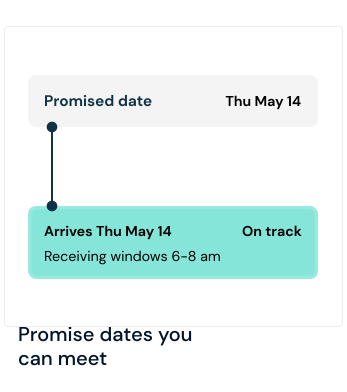
The date your customer sees online is the date your warehouse ships to hit. Both are rendered from the same transit prediction.
01
The promise/execution sync
Offer exact delivery dates, then meet them
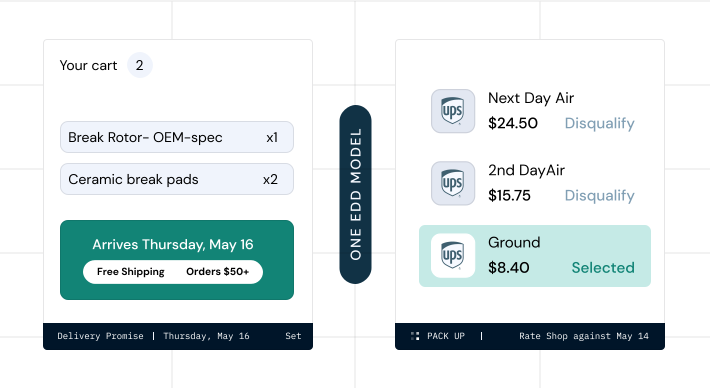
Stand out from your competition by offering exact dates, not ranges. Shipium uses one ML-powered EDD model across promise and execution. The date your customer sees is the date your warehouse ships to hit.
HOW IT WORKS
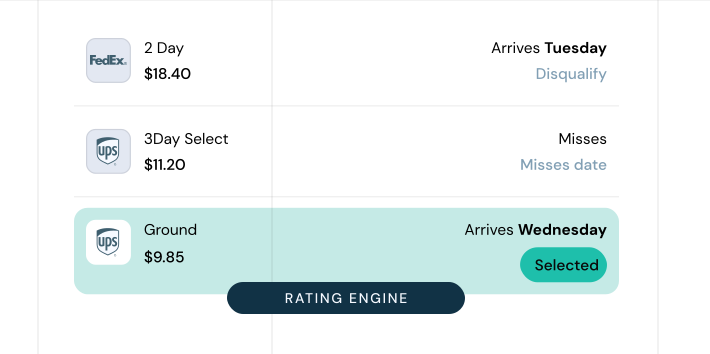
Delivery Promise returns an accurate promise date to your frontend. At pack-out, Rating Engine evaluates every eligible carrier and service against that date and selects the cheapest method that will arrive on time.
02
Fulfillment diversity, treated correctly
Use one platform across fulfillment strategies
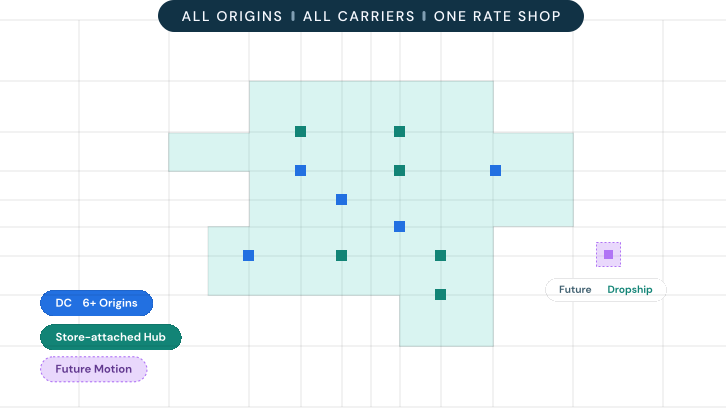
You may be shipping from regional DCs, stores, or directly from vendors. Shipium models each origin's actual carrier mix, schedules, cutoffs, and historical performance. Every rate shop reflects the real fulfillment context for each shipment.
HOW IT WORKS
Every origin gets its own carrier mix and schedule. When dropshipping or ship-from-store goes live, the same platform absorbs the new motion with no new technology vendor or integration.
03
KEEP DATES, SAVE ON COSTS
Intelligently downgrade services without missing promise dates
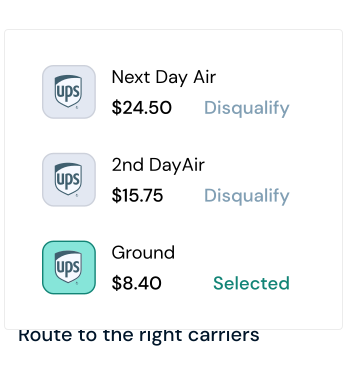
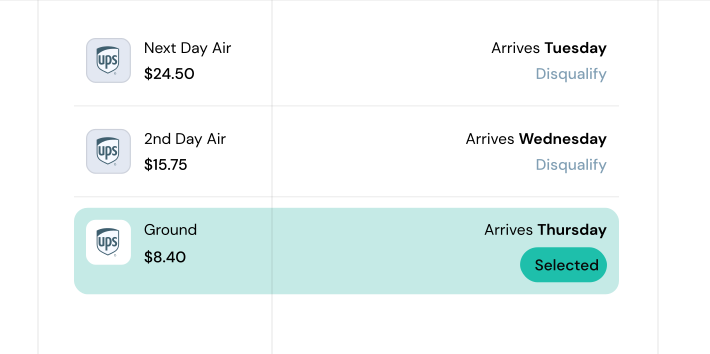
Many incumbent systems can't evaluate full carrier constraints (real rates, real rules, accurate transit time, capacity limits). As a result, customers get overnight when ground would have hit the date, and the operator pays the premium. Shipium's Rating Engine evaluates every eligible carrier and service against a host of constraints, then picks the cheapest method that arrives on time.
HOW IT WORKS
Rate shopping runs against the EDD model's prediction, not against a static transit table. Service downgrades happen automatically when ground is provably on-time.
Modern shipping intelligence that works with your existing systems
Manufacturers ship a wider mix than almost anyone else. Multi-carton replenishments to distributors, individual parcel orders to technicians, hazmat. Not to mention, many manufacturers run shipping out of an ERP that wasn't built for it. Shipium enables you to handle modern shipping complexity while integrating with your existing systems.
What changes
Shipping technology for modern operators.
Shipium integrates existing systems to orchestrate shipping decisions, provide visibility, and support new initiatives.
01
reliable, scalable ERP integration
Modern shipping technology, integrated with your ERP
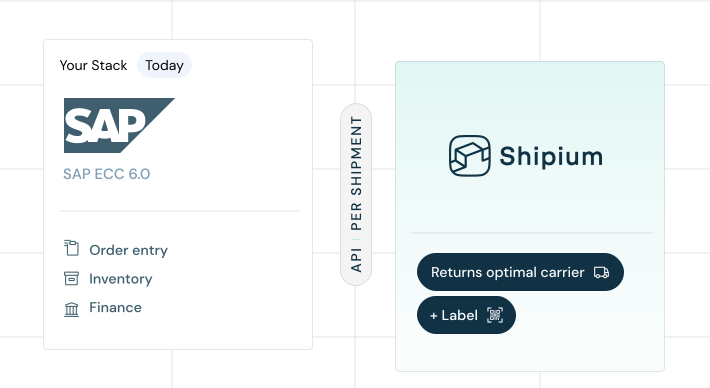
The ERP — whether SAP, Oracle, or a custom solution — is load-bearing for almost everything. Shipium's API-first architecture allows for reliable integrations without requiring an ERP migration or re-platform.
HOW IT WORKS
Proven integration frameworks and managed implementations connect Shipium's APIs to your ERP. The ERP keeps doing what it does. Shipium handles the shipping decisions.
02
advanced rate shopping for modern shipping complexity
Compare every carrier on real constraints, not legacy rules
Most ERPs select carriers based on rules set at implementation: "Use UPS Ground for orders under 50 lbs to X region." Rules don't update when carriers change rates, transit times shift, or new carriers become available. Shipium evaluates every shipment at decision time against the desired delivery date and picks the carrier and service that will hit it at the lowest cost.
HOW IT WORKS
Rating Engine runs against the desired delivery date and ranks every eligible carrier and service on fully-loaded cost, accurate transit time, and capacity. Rules are dynamic and support advanced rate shopping workflows.
Intelligent fulfillment on one platform
High-tech operators rarely ship one way, and many in the space have inherited three or four shipping systems through platform sprawl. Each has its own carrier contracts, its own rate logic, its own data. By contrast, Shipium optimizes and executes every shipping decision, with carrier contracts, physical network design, and visibility unified in one platform.
What changes
Do away with the patchwork of carrier portals, spreadsheets, and disconnected shipping systems.
01
One platform, every motion
Stop running three shipping systems for three workflows
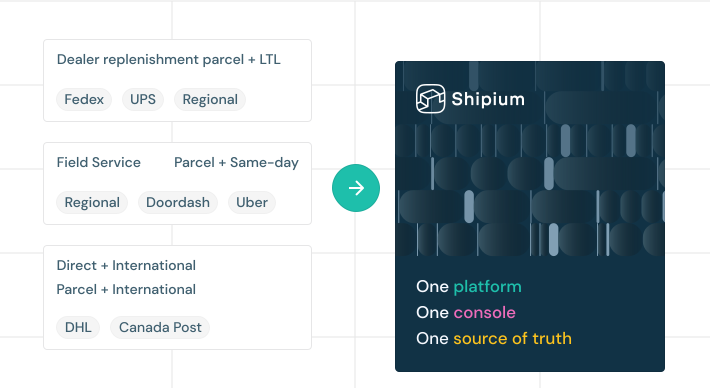
Shipium runs every motion through one platform using the same console, same rules engine, same carrier contracts, and same data.
HOW IT WORKS
Every shipping motion (ex. dealer, service, direct, international) is configured as a rule set on one platform. New motions don't require new vendors. They're configured, not procured.
02
Negotiate against total volume
Hit contract tiers more intelligently
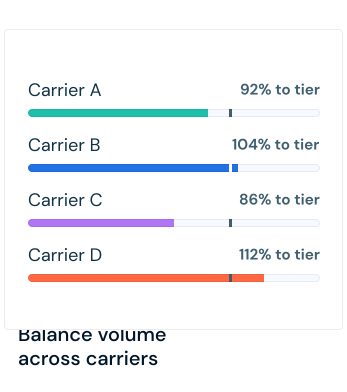
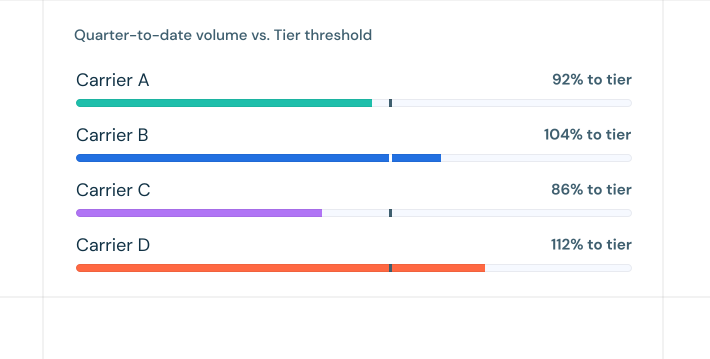
Volume tiers, lane commitments, and service-method minimums all complicate the carrier selection process. When shipping motions live in separate systems, volume gets allocated by which system happens to handle each shipment, causing shippers to miss their incentive thresholds. Shipium's Carrier Load Management tracks every commitment against real allocation and routes shipments to where they need to be.
HOW IT WORKS
Carrier Load Management monitors commitment status against negotiated tiers, and the Rating Engine factors tier-position into per-shipment routing decisions.
03
Replace the FP&A spreadsheet
See cost-per-package by carrier, lane, origin and more
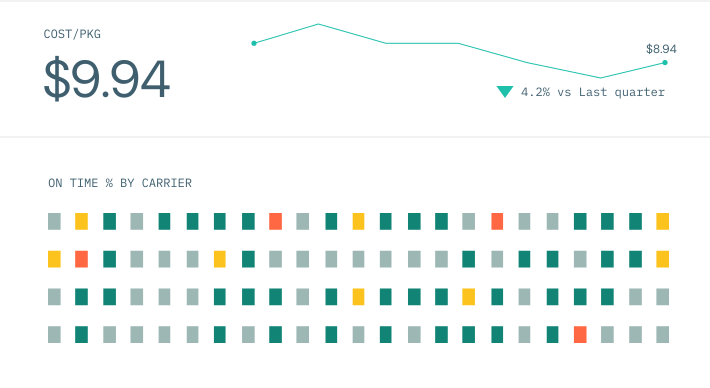
Shipping costs are often reconstructed after the fact: pulling carrier invoices, mapping to GL codes, allocating to lanes, comparing to budget. By the time it's done, the quarter is over and it's too late to recover margins. Shipium Orca AI Analytics surfaces cost-per-package, on-time performance, exception rates, carrier mix and more. Natural language prompting can be used for deeper analysis.
HOW IT WORKS
Orca AI Analytics pulls execution data from every shipment, and renders it in a centralized view that finance and ops can both use.
How Shipium creates value for B2Bs
The shipping intelligence B2B operators actually need.
Cut the costs your incumbent system leaves on the table. Hit the dates your customer's operations depend on. Run it all from one platform across subsidiaries, systems, and origins.
02
Operational precision
Replace static transit tables with ML-powered delivery date predictions that reflect real-world performance. Select the right carrier and service to hit the date your customer's operations depend on. Track every shipment against the promised date and catch slipping deliveries before your customer does.
03
Centralized control and visibility
One platform for execution and measurement across every fulfillment workflow. Manage carriers, rules, and analytics from a single console with no IT tickets. Tie execution data to billing and FP&A. Evaluate cost drivers, carrier performance, and network health.
Visibility, finally
Analytics built on your execution data, not bolted on top of it.
Most B2B analytics tools pull carrier invoices, normalize them in their own warehouse, and surface a dashboard a week later. Shipium's analytics layer runs on the same execution data that runs your shipping decisions — so cost-per-package, on-time performance, carrier mix, and contract tier status are visible the moment the shipment ships, not the next time a finance team reconciles.
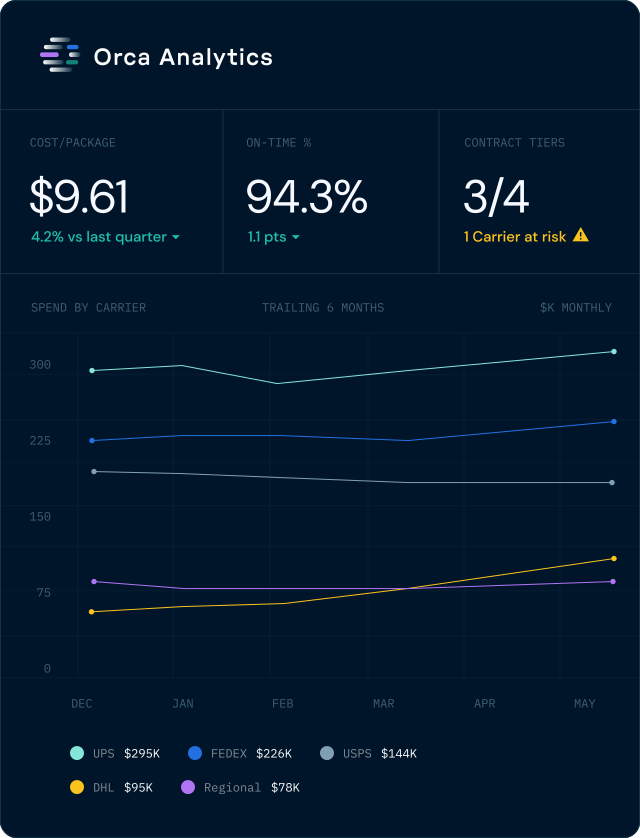
See every shipment detail.
Drill into KPIs like cost-per-package and on-time performance by carrier, lane, origin and more. Reports are automatically updated as data from executed shipments becomes available.
See every dollar.
Expected execution costs are reconciled against carrier invoices, with detailed analytics to support cost reduction strategies. Spend insights that used to live in an FP&A spreadsheet now live in a dashboard.
shipping data + ai analytics
Know your network
Gain detailed analytics on all key aspects of your shipping performance, and use natural language to drill deeper into your data.
The platform by use case
Explore Shipium's solutions to see exactly what they do for your business
Strategy & Planning
Customer Experience
Shipping Optimization & Execution
Ops & Financial Controllership
Simulation
Prove the savings before you commit the budget.
Model the impact of a newly acquired business unit, a new carrier mix, or a network change against your real shipment history before you commit. Used to build the internal business case for procurement and finance. Used in ops to stress-test capacity decisions before you make them.
Orca AI Analytics
Spot margin erosion across business units before it becomes a quarterly problem.
See carrier performance, lane economics, and shipping cost by business unit in real time vs. a monthly report — the visibility most B2B networks lack today. Powered by an AI analytics engine purpose-built for shipping data, with natural language querying for custom visualizations and deeper analysis.
Delivery Promise
Show accurate dates when the order is placed. Reduce surprises after it ships.
Generate precise delivery date promises when a business customer places an order — backed by ML models trained on your network's real performance. Set expectations you can keep on the parts, components, and replacement goods your customers are waiting on.
Delivery Date Enhancement
Tighter, more accurate delivery dates at every customer touchpoint.
Improve the delivery dates shown to business customers by combining your OMS inventory data with Shipium's transit prediction models. Upgrade dates from static, carrier-provided ranges to precise commitments.
Shipment Tracking
Real-time visibility into every shipment, across every carrier.
Unify tracking events across every carrier in your network into one standardized feed. Power customer notifications and exception handling with clean, standardized data — instead of stitching together carrier portals.
Route Optimization
Pick the right origin and time every shipment accurately.
Select the optimal fulfillment node for every order across your multi-node network — balancing inventory, carrier availability, cost, and SLA. Handles splits, pre-commit routing, and origin re-selection when upstream conditions change.
Rating Engine
Optimize every carrier decision — and protect margin — at the moment of shipment.
Score every available service against cost, speed, and SLA at shipment time. Apply your own carrier-selection and markup rules. Downgrade air to ground whenever SLAs will hold.
Label Engine
Generate compliant labels at scale, including offline scenarios.
Print labels for every carrier, every service, and every compliance requirement — including hazmat shipments and offline scenarios. Built to handle volume without falling down.
Carrier Load Management
Balance volume across carriers in real time.
Shift volume across carriers dynamically based on capacity, performance, and contract commitments — including the regional and industry-specific carriers you're adding to the mix. Prevent over-allocation to any one carrier. Stay inside your negotiated rate brackets.
Pack Station
Standardize pack workflows across nodes and business units.
A pack station UI that works across warehouses, nodes, and business unit setups. Drive consistent pack quality, capture accurate dims and weights at source, and reduce downstream billing disputes and chargebacks.
Ship-from-Store
Turn branches and distribution points into fulfillment nodes without a rebuild.
Enable fulfillment from branches, depots, or distribution points with the same rules, rate shopping, and label engine your warehouses use. Orchestrate the site → carrier handoff without bolting on a separate system.
Address Validation
Catch bad addresses before they become failed deliveries or exception costs.
Avoid address correction surcharges, failed deliveries, and return-to-sender fees — which compound across volume and disrupt the customers depending on your shipments.
Dropshipping
Run vendor-fulfilled orders through the same shipping system.
Extend Shipium's rating, labeling, and tracking to supplier and distributor partners so vendor-fulfilled orders hit the same SLAs and cost thresholds as your own shipments.
Mode Optimization
Pick parcel vs. LTL automatically.
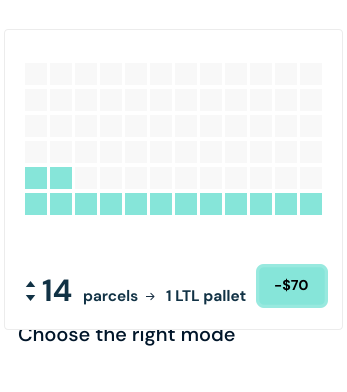
Evaluate whether parcel or LTL delivers the best cost-to-SLA outcome and route accordingly — important when your shipments span small parcels and heavier, palletized loads.
Zone Skipping
Move volume injected closer to destination.
Consolidate shipments destined for the same region, line-haul them to an injection point, and hand off to the carrier for final-mile — collapsing zones and cutting cost on high-volume lanes.
Packaging Optimization
Reduce DIM weight charges. Standardize packaging by SKU.
Recommend the right box for every order based on SKU dimensions, shipment composition, and carrier DIM rules. Cut dimensional weight charges and reduce packaging waste at the same time.
International Shipping
Ship cross-border without a cross-border team.
Pre-integrated international carrier network including Passport, Asendia, and regional specialists. Handle duties, landed cost, and compliance documentation without building custom connections per lane.
Billing Management
Allocate shipping cost accurately across business units — or bill downstream customers faster.
Generate invoices and cost allocations from real shipment data — with fully-loaded costs, markup rules, and accessorial handling already applied. Tie shipping spend back to finance, by business unit.
Invoice Management
Reconcile carrier invoices against expected charges.
Ingest carrier invoices via API, EDI, or file transfer. Match line items against shipment-time rates. Flag discrepancies down to the accessorial. Recover surcharge overcharges that today slip through and erode margin.
Digital Twin
A live model of your network.
Every shipment, carrier decision, rate, and outcome in your network — continuously modeled across business units. Digital Twins power ML optimization, make Simulation possible, and ensure Orca AI Analytics are accurate and actionable.
Rules Engine
Configure global and business-unit-specific logic without an IT ticket.
A universal rules engine that sits under every shipping decision — carrier selection, packaging, labeling, routing. Your supply chain team changes logic from the console — no service orders, no waiting on internal IT.
Console
Centralized control across every shipping decision.
One interface to manage business units, carriers, rules, rates, and analytics. Replaces the disconnected mix of carrier portals, rate cards, and the multiple TMS systems most B2B networks have accumulated through M&A.
Carrier Network
60+ pre-integrated carriers. 200+ service methods.
Nationals, regionals, internationals, and alternatives — all pre-integrated and ready to configure. When your network needs a new regional, an alternative carrier, or a new carrier service, you add it in days, not weeks.
Integration Framework
Get the most from your current stack.
Configuration-ready integration frameworks with the WMS, OMS, and ERP systems B2B companies depend on — SAP, Oracle, Blue Yonder, Manhattan, Körber, and more. No integration issues with the systems you already run.
ML Models
The intelligence layer under every Shipium decision.
Purpose-built ML models trained on the industry's largest shipping dataset — powering accurate delivery promises, optimal carrier selection, and the predictive analytics your team runs every day.
The proof is everywhere
Carriers, partners, and analysts agree — Shipium is setting a new standard for fulfillment technology.

Recognized as a leader and Cool Vendor in the Multi Carrier Parcel Management Solution space by analyst firm Gartner

UPS Ready 2025 Impact POTY

FedEx Compatible

DHLeC
Certified Partner

USPS Direct Partner

PwC Strategic Partner

McKinsey Trusted Advisor
Built for your most pressing use cases
See common challenges B2B operators are solving with Shipium
Consolidating shipping across acquired subsidiaries
B2B operators whose systems grew through acquisition have inherited multiple TMSs, multiple shipping engines, and multiple sets of carrier contracts. This limits visibility into total spend, prevents the enforcement of consistent rules, and limits negotiation leverage.
Without Shipium
Each business unit runs its own shipping stack. Procurement negotiates carrier contracts in isolation. Total shipping spend is reconstructed from invoices weeks after the fact. Operating standards drift across acquired companies.
With Shipium
One console replaces N TMSs. Carrier contracts cover total volume across business units. Rules and analytics are unified. Business units keep their own operational autonomy where it matters, but execution runs through one platform.
Outcome
One console replacing the patchwork of TMSs, carrier portals, and FP&A spreadsheets.
Total spend visible in real time. Carriers negotiated against full volume.
Migrating to a modern WMS, OMS, or ERP
SAP, Oracle, Manhattan Active, and BY Cloud are actively pushing customers to migrate. The migration usually exposes how poorly the incumbent shipping system integrates. You need shipping technology that supports the migration, not one that holds it up.
Without Shipium
The incumbent shipping system was built for the legacy WMS. Migration requires either a heavy re-integration project or a parallel shipping vendor that adds cost and complexity. Shipping becomes a critical-path blocker.
With Shipium
API-first architecture and pre-built integrations to SAP, Oracle, Manhattan Active, and Blue Yonder mean shipping integrates cleanly — and stays integrated as the WMS/OMS/ERP evolves. Shipium becomes the constant across migration phases.
Outcome
Shipping technology that supports your platform migration — not one that holds it up.
Finding parcel-to-LTL mode shift opportunities
B2B operators leak money in both directions on mode. Multi-box replenishments that should consolidate as LTL ship as parcel because the rules can't see across the shipment. Small-package orders that should ship parcel get sent LTL because the system defaults haven't been updated since the network changed.
Without Shipium
Mode decisions follow static rules set at implementation. A 14-box replenishment ships as 14 parcels because nothing in the system consolidates. A 3-box order goes LTL by default. Cost leaks accumulate quietly across thousands of shipments per month.
With Shipium
Mode Optimization evaluates every shipment for parcel-vs-LTL economics at decision time. Consolidation happens automatically when LTL is cheaper and still hits the window. Small packages stay parcel. The right mode runs on every shipment.
Outcome
Mode decided per shipment, not per default.
Maximizing carrier contract incentives
B2B carrier contracts are sophisticated — volume tiers, lane commitments, service-method minimums, peak adjustments. Most operators can see their contract terms; few can see in real time whether they're tracking toward incentive thresholds. By the time procurement sees the gap, the quarter is over.
Without Shipium
Volume gets allocated to carriers based on which system handles each shipment. Contract incentives miss the tier because no one was watching the threshold in flight. Procurement learns about the gap at the QBR.
With Shipium
Carrier Load Management monitors every commitment in real time. Rating Engine factors tier-position into routing decisions. Volume gets allocated to where it earns the incentive — and procurement sees the threshold tracking before it slips.
Outcome
Contract incentives hit — by design, not by accident.
Recovering carrier billing discrepancies
Carrier invoices arrive weeks after shipments. Matching them to specific shipments to dispute overcharges is a manual exercise most B2B operations don't have time for — so they absorb. Billing Management automates the reconciliation that ops teams can't.
Without Shipium
Invoices flow to AP. Matching them to shipments is manual. Most discrepancies get absorbed because the recovery isn't worth the labor.
With Shipium
Billing Management auto-matches invoices to execution records. Overcharges, misapplied accessorials, and rate discrepancies are flagged automatically. Disputes are tracked through resolution. Recovery becomes routine.
Modules involved
Outcome
Recovered, not absorbed.